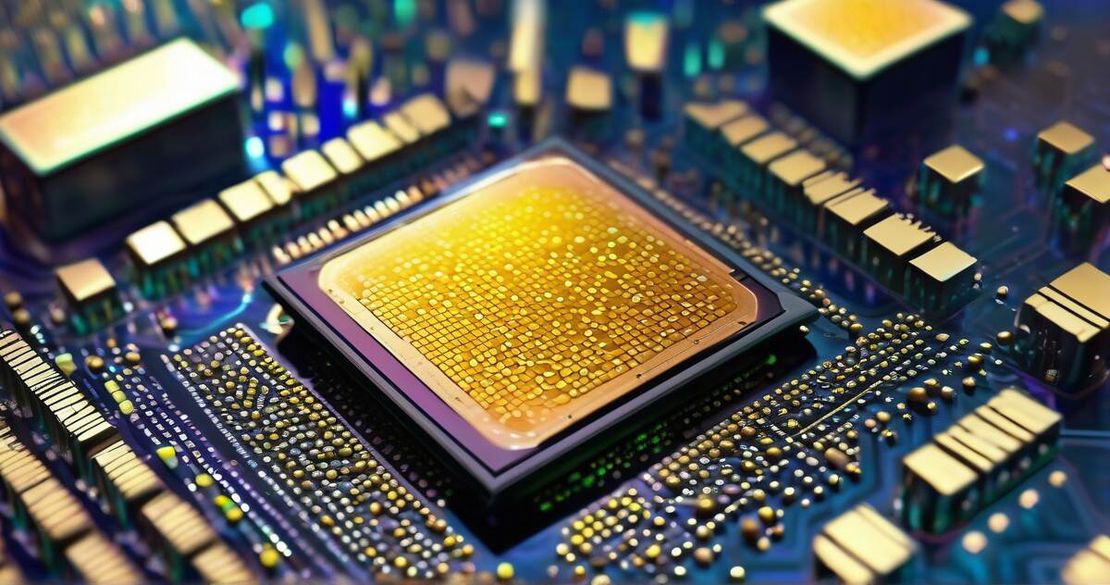
Discover how China’s new analog computing chip using R-RAM delivers 1,000-fold speed, 100-fold power savings, and 100,000-fold precision, reshaping AI, 6G, and the global tech race.
Analog Computing Shakes the AI World: 1,000-X Speed, 100-X Power, 100,000-X Precision
Published by Brav
Table of Contents
TL;DR
- Analog chip using R-RAM can do AI matrix math 1,000× faster than a top Nvidia GPU Nature Electronics — Precise and scalable analog matrix inversion solver (2025).
- It uses 100× less energy, cutting a GPU’s 700 W draw to about 7 W NVIDIA — H100 Power Consumption (2025).
- Precision rivals 32-bit digital systems, a 100,000× leap over old analog designs Peking University — Breaks 100-year barrier (2025).
- China’s subsidies cut power bills by up to 50 % for data-center operators China — Subsidies for AI Chip Data Centers (2025).
- The breakthrough could speed AI training from months to days, power 6G massive-MIMO arrays, and enable on-device inference Nature Electronics — Precise and scalable analog matrix inversion solver (2025).
Why this matters
I still remember the night I was hunched over a rack of Nvidia H100 GPUs, watching the fans spin as the power meter jumped to 700 W. That was a familiar picture for every AI engineer: a GPU that can handle massive neural-network training, but it eats electricity like a black hole. Every year, the cost of cooling and electricity is a huge part of a data-center budget. NVIDIA — H100 Power Consumption (2025).
Now imagine the same workloads on a chip that runs 1,000× faster and uses 100× less power. That’s the promise of the new analog chip built from resistive random-access memory (R-RAM). It was published by Peking University on October 13, 2025 in Nature Electronics Nature Electronics — Precise and scalable analog matrix inversion solver (2025). The world of AI, 6G communications, and the geopolitical chessboard just got a new piece.
Core concepts
Analog computing is not a new idea. Early machines in the 1930s and 1940s solved differential equations by letting electrical currents flow in wires. The problem was noise and drift, which made the calculations unreliable for the kind of precise math we need today. That’s why the digital era took over: binary logic gives clean, repeatable results.
The breakthrough at Peking University changes the equation. The chip uses tiny R-RAM cells that can hold many different resistance levels, not just “0” or “1”. By measuring the current that flows through each cell, the chip performs many matrix operations in parallel—exactly what AI training and 6G signal-processing need. In tests, it solved 16 × 16 matrix inversion problems with 24-bit fixed-point precision, a level that matches 32-bit floating-point digital processors Nature Electronics — Precise and scalable analog matrix inversion solver (2025).
| Technology | Parameter | Use Case | Limitation |
|---|---|---|---|
| Analog RRAM chip | 1,000× throughput, 100× energy efficiency, 24-bit precision | AI training, 6G massive-MIMO, edge inference | Needs new software stacks, limited to analog-friendly workloads |
| NVIDIA H100 GPU | Baseline throughput, 700 W power, 16-32-bit precision | General AI training, HPC | High power consumption, von Neumann bottleneck |
| Photonic chip | High throughput, low power (mW), precision varies | Optical interconnects, high-speed data | Early stage, high cost, integration complexity Chipix — Photonic chip production (2025) |
The table above shows how the analog chip outperforms a top GPU in every metric that matters to data-center operators: speed, power, and precision. It also shows that the technology is not a single trick—it can power the next generation of wireless networks. 6G networks will rely on massive multiple-input multiple-output (MIMO) arrays, which involve huge matrix calculations. The analog chip can crunch those numbers in real time, freeing up servers and reducing latency Nature Electronics — Precise and scalable analog matrix inversion solver (2025).
How to apply
If you’re in a data-center or research lab, the first step is to look at your workload mix. The analog chip is a specialist for linear-algebra–heavy tasks: matrix multiplication, inversion, and signal-processing kernels. Here’s a quick playbook:
- Identify critical kernels – In your training pipeline, find the loops that spend the most time on matrix math. That’s where the chip can make the biggest difference.
- Prototype with a simulator – Most analog designs require a new software stack. The Peking University paper released an open-source simulator that models R-RAM behavior. Use it to estimate speed-up and energy savings for your workload.
- Validate on hardware – A prototype chip was built using commercial 3-nm-style processes. If you have a partner with a fab that can do R-RAM, you can get a test wafer. The chip’s performance is independent of the process node, which is a huge advantage in a supply-chain-tight world.
- Scale to clusters – The chip’s memory and compute are integrated, so you can pack many of them into a single module. That keeps inter-chip data movement to a minimum, breaking the von Neumann bottleneck that plagues GPUs.
- Monitor power – With 100× lower energy, your cooling budget drops dramatically. China’s recent subsidies cut power bills for large data centers by up to 50 % China — Subsidies for AI Chip Data Centers (2025).
Pitfalls & edge cases
The analog chip is a game-changer, but it’s not a silver bullet.
- Software stack – Most AI frameworks are written for digital CPUs and GPUs. You’ll need a new compiler or a hybrid runtime that can offload linear-algebra sub-routines to the analog device. The research team released a prototype compiler, but it is still early.
- Reliability – R-RAM cells can drift over time, especially under heat. The paper shows a 24-bit precision over a few weeks of testing, but long-term endurance is still under study. Your data-center’s uptime requirements may demand more testing.
- Workload fit – If your workloads are more graph-based or involve branching, the analog chip offers little advantage. It shines on dense, parallel matrix math.
- Supply chain – While the chip uses commercial processes, you still need a fab that can produce R-RAM arrays. China has ramped up production, but availability outside of China might be limited for the next year.
- Regulatory risk – China’s rapid push for analog and photonic chips may trigger new export controls. The U.S. sanctions on GPUs already accelerated domestic R-RAM development, but future policy could shift again.
Quick FAQ
| Q | A |
|---|---|
| What is analog computing? | A way to do math by letting electrical signals flow in circuits, instead of flipping binary switches. |
| How does R-RAM improve precision? | Each cell can hold many resistance levels, giving the chip 24-bit precision—about 100,000× better than old analog chips. |
| Does the analog chip replace GPUs? | Not entirely. It’s a specialist for linear-algebra work; GPUs are still best for many other tasks. |
| Can I run AI on a single device? | Yes, edge devices can use a low-power analog chip for inference, eliminating the need for cloud connectivity. |
| Why is China winning the AI race? | The chip was built without U.S. advanced GPUs, uses cheap local electricity, and shows massive speed-up, giving China a competitive edge. |
| Will Western firms adopt this tech? | It’s still early, but the performance gains and energy savings make it attractive. Some companies are already exploring analog or photonic research. |
| What about reliability? | R-RAM reliability is still being studied; early tests show 24-bit precision over a few weeks. |
Conclusion
I’ve seen GPUs rise and fall. They dominate now, but the energy wall is closing in. The analog chip from Peking University flips the script. With 1,000× speed, 100× power savings, and 100,000× precision, it can transform AI training, 6G communications, and edge inference. If you’re a semiconductor engineer or AI researcher, this is a technology you need to understand, prototype, and eventually ship. The future of high-performance computing may well be in continuous currents, not binary bits.



![AI Bubble on the Brink: Will It Burst Before 2026? [Data-Driven Insight] | Brav](/images/ai-bubble-brink-burst-data-Brav_hu_33ac5f273941b570.jpg)