Learn how to harvest rainwater into electricity with a plug-flow tube and build a DIY generator that powers LEDs, ideal for makers, hobbyists, and educators.
I Built a Plug-Flow Rainwater Generator That Lights LEDs With 6 kV – A Step-by-Step Demo
Published by Brav
Table of Contents
TL;DR
- Build a 32-cm, 2-mm ID polymer tube and a syringe to create intermittent droplet flow.
- Use fluorinated polyethylene to boost ionization by up to 1,000×.
- The plug generates >10 % conversion and a peak of ~6 kV, enough to pop neon lamps.
- No pumps or turbines are needed; just gravity and a simple valve.
- Scale by adding parallel tubes, but safety and maintenance become critical.
Why This Matters
For hobbyists and educators, the idea that a tiny vertical tube can turn rain into a kilovolt spark is more than a novelty; it shows that charge separation can be harnessed from the simplest moving fluid. The ACS study proved that a 32-cm, 2-mm tube can harvest over 10 % of the kinetic energy of falling droplets and produce a voltage of ~6 kV, enough to light a string of LEDs or a neon lamp.
Core Concepts
| Parameter | Meaning | Why it matters |
|---|---|---|
| Plug flow | Discrete water plugs separated by air | Eliminates mixing, maximizing charge separation |
| Fluorinated polyethylene | High-surface-energy polymer | Amplifies ionization up to 1,000× |
| High-voltage output | 100 V–6 kV | Directly lights LED or neon indicators |
| Low current | < 10 mA | Safer for DIY, minimal heating |
The voltage comes from a clean separation of ions: droplets push against the tube wall, pulling hydroxide ions to the surface and leaving hydronium ions in the flow. Because the tube is short and the water moves steadily, a measurable potential builds up.
How to Build It
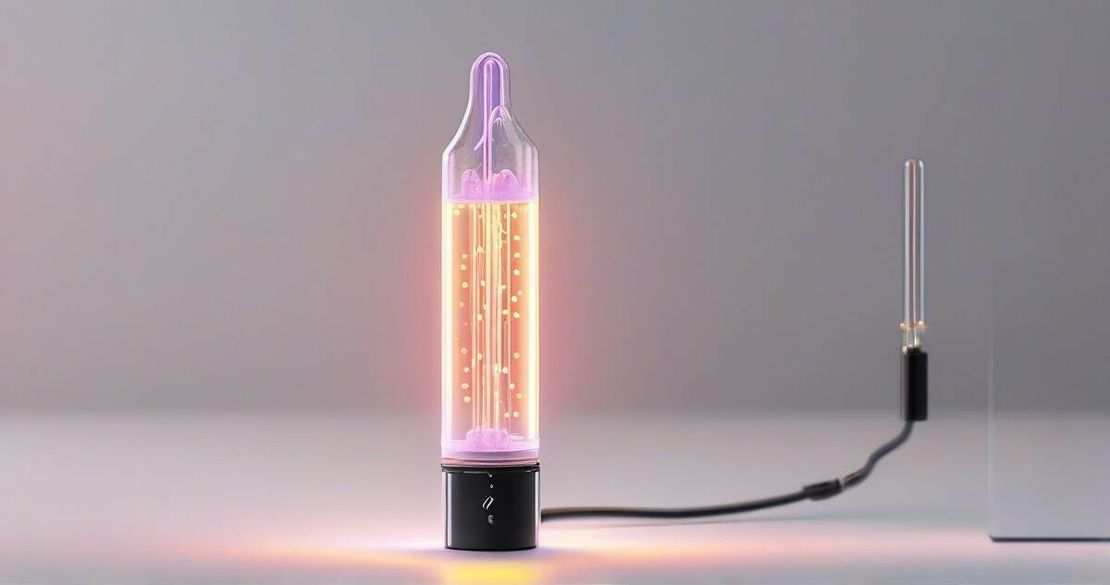
- Materials: 32 cm FEP tube, 18-gauge stainless-steel needle, 10 mL syringe, on/off valve, distilled water, copper wires, neon or LED lamp.
- Assembly: Clamp the tube vertically. Insert the needle through the bottom so its tip sits ~1 cm inside. Connect the syringe to the top with a tee fitting; attach the valve to the syringe’s plunger.
- Set up water: Fill the syringe with distilled water.
- Create plug flow: Pull the plunger to build pressure, then release in one quick motion. The droplets enter the tube, forming a plug separated by a pocket of air.
- Electrode connection: Attach one wire to the needle (electrode) and the other to a metal ring on the tube base.
- Observation: Place a neon lamp near the needle and the base. As water plows, a spark will jump across the gap, lighting the lamp.
Measure the voltage with a high-voltage probe; peaks reach ~6 kV, with an average of 1–2 kV and a current of <10 mA.
Common Pitfalls
| Issue | Fix |
|---|---|
| High-voltage hazard | Use insulated gloves and keep the setup away from flammables |
| Tube wear | Replace FEP tube every few months |
| Flow loss | Tighten valve and ensure the syringe plunger stays sealed |
| Low current for electronics | Use a step-down converter if you need DC power |
FAQs
- What is plug flow? – Isolated droplets moving at the same speed, separated by air.
- Can I use tap water? – Yes, but mineral scaling may shorten tube life.
- Is it safe? – High voltage is present; keep the setup dry and out of reach of kids.
- How to increase power? – Add more tubes in parallel, but ensure each remains isolated.
- What about converting the high voltage? – Use a transformer or a DC-DC converter; the current is very low.
Takeaway
A simple vertical tube, a syringe, and a bit of high-energy polymer can harvest electricity from falling water. It’s a low-cost, low-maintenance demo that teaches the fundamentals of electrochemistry and renewable energy. Whether you’re a teacher, maker, or engineer, try the plug-flow generator and see how much power you can pull from a raindrop.
References
Siowling Soh — Plug Flow: Generating Renewable Electricity with Water from Nature by Breaking the Limit of Debye Length (2025) Science Daily — A step toward harnessing clean energy from falling rainwater (2025) Siowling Soh — Plug Flow: Generating Renewable Electricity with Water from Nature by Breaking the Limit of Debye Length (2025) FEP Tubing Overview (2025) The Autoionization of Water (2025)