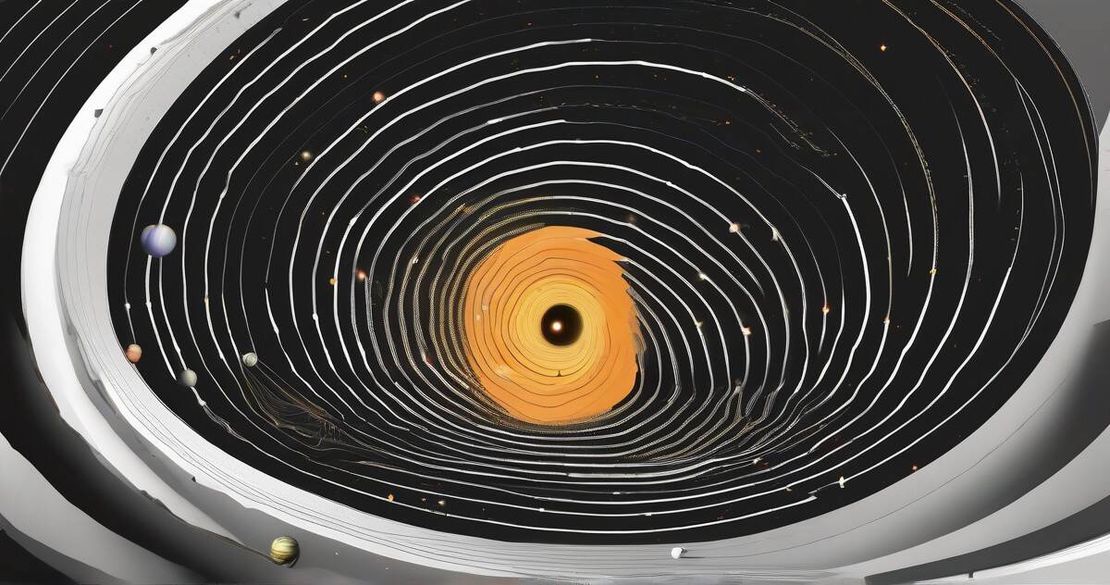
Explore how gravity is spacetime curvature, why GPS needs relativity, and how LIGO listens to cosmic ripples—your guide to the geometry of the universe.
Gravity, Not a Force: Inside the Geometry of the Cosmos
Published by Brav
Table of Contents
TL;DR
- Gravity isn’t a force but the shape of spacetime.
- Einstein’s equations explain Mercury’s wobble, GPS, and black holes.
- LIGO now listens to spacetime ripples.
- Dark matter and dark energy drive cosmic expansion.
- A rolling marble on a sheet illustrates gravity.
Why this matters
I remember a physics class that taught gravity as a force pulling planets together. The math worked for Earth-Sun, but it failed for Mercury and light bending. GPS satellites drift by microseconds if we ignore relativity, turning meters into navigation errors. Without grasping gravity, we can’t build better sensors or predict cosmic events.
Core concepts
- Gravity is curvature, not a force. Mass and energy bend spacetime; matter follows the curvature. Einstein — General Relativity (1915)
- Geodesics are the straightest paths in curved space. Think of a marble rolling on a warped sheet. Einstein — General Relativity (1915)
- Equivalence principle: free-falling elevator feels weightless; local physics identical to deep space. Einstein — General Relativity (1915)
- Time dilation: clocks near a mass run slower; GPS must add 38 µs/day. GPS — Relativity (2023)
- Gravitational lensing bends light around massive galaxies, mapping dark matter. Gravitational Lensing (2023)
- Gravitational waves are ripples from accelerating masses; first direct detection by LIGO in 2015. LIGO — First GW detection (2015)
- Black holes: event horizon, Hawking radiation, slow evaporation. Schwarzschild Radius (2023) Hawking Radiation (2023)
| Concept | Use Case | Limitation |
|---|---|---|
| Newtonian Gravity | Planetary orbits | Fails near strong gravity |
| General Relativity | Mercury perihelion, lensing | Requires tensor calculus |
| Gravitational Waves | LIGO detection | Extremely weak |
How to apply it
- Visualize spacetime: rubber sheet with bowling ball.
- Newton’s law:
Newton — Principia (1687)F = G m1 m2 / r^2 - Einstein’s equations:
Einstein — General Relativity (1915)G_{μν} = 8π T_{μν} - GPS corrections: gravitational shift + kinematic shift = 38 µs/day. GPS — Relativity (2023)
- LIGO: 4 km arms, laser interferometry, strain ~10⁻²¹. LIGO — First GW detection (2015)
Pitfalls & edge cases
- Singularities: black hole center, curvature blow-up, need quantum gravity. Black Hole — Singularity (2023)
- Spaghettification: tidal stretching near supermassive black holes. Spaghettification (2023)
- Frame dragging: rotating mass drags spacetime. Frame Dragging (2023)
- Dark matter/energy: still unknown.
Quick FAQ
- What is gravity? Curvature of spacetime.
- GPS and relativity? Time dilation corrections keep navigation accurate.
- Gravitational waves? Ripples in spacetime.
- Measuring waves? LIGO interferometers.
- Dark matter? Invisible mass, 27 %.
- Dark energy? 68 % of energy, accelerates expansion.
- Spacetime propulsion? Alcubierre drive speculative.
Conclusion
Gravity is geometry, not a force. Visualize, calculate, apply, explore. Dark matter, dark energy, quantum gravity await.
References
- Newton — Principia (1687) : https://en.wikipedia.org/wiki/Principia
- Einstein — General Relativity (1915) : https://en.wikipedia.org/wiki/General_relativity
- Mercury Precession (2023) : https://en.wikipedia.org/wiki/Mercury_(planet)#Precession_of_the_orbit
- LIGO — First GW detection (2015) : https://www.ligo.caltech.edu/story/first-gravitational-wave-detection
- GPS — Relativity (2023) : https://en.wikipedia.org/wiki/Global_Positioning_System#Relativity
- Gravitational Lensing (2023) : https://en.wikipedia.org/wiki/Gravitational_lensing
- Schwarzschild Radius (2023) : https://en.wikipedia.org/wiki/Schwarzschild_radius
- Dark Matter (2023) : https://en.wikipedia.org/wiki/Dark_matter
- Dark Energy (2023) : https://en.wikipedia.org/wiki/Dark_energy
- Black Hole — Singularity (2023) : https://en.wikipedia.org/wiki/Black_hole#Singularity
- Spaghettification (2023) : https://en.wikipedia.org/wiki/Spaghettification
- Frame Dragging (2023) : https://en.wikipedia.org/wiki/Frame_dragging
- Expansion of the Universe (2023) : https://en.wikipedia.org/wiki/Expansion_of_the_universe
- Cosmic Microwave Background (2023) : https://en.wikipedia.org/wiki/Cosmic_microwave_background
- Hawking Radiation (2023) : https://en.wikipedia.org/wiki/Hawking_radiation
- Gravitational Wave (2023) : https://en.wikipedia.org/wiki/Gravitational_wave
- Event Horizon Telescope (2023) : https://en.wikipedia.org/wiki/Event_Horizon_Telescope
- Hulse–Taylor binary pulsar (2023) : https://en.wikipedia.org/wiki/Hulse%E2%80%93Taylor_binary
- Gravitational Time Dilation (2023) : https://en.wikipedia.org/wiki/Gravitational_time_dilation