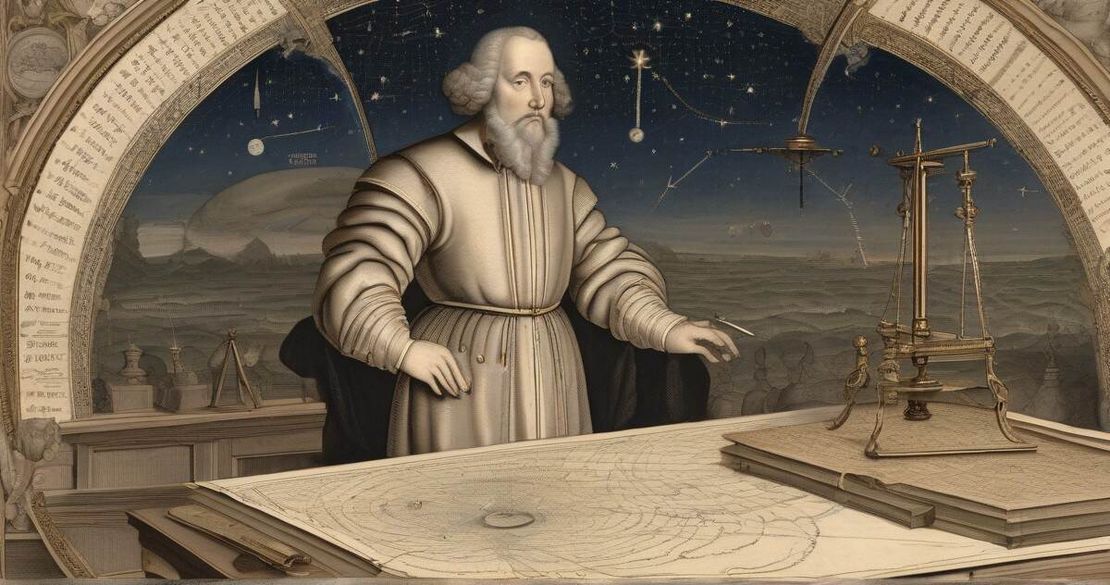
Discover how John Napier’s logarithm tables and Kepler’s genius turned tedious 7-digit multiplication into simple addition, leading to the first accurate star catalog and the discovery of planetary laws. Read this practical guide for history of science and math students.
Logarithms: The Spark That Turned Astronomical Calculations into Lightning
Published by Brav
Table of Contents
TL;DR
- Logarithms turned tedious 7-digit multiplication into simple addition.
- Johannes Kepler’s use of Napier’s tables helped him nail his Third Law in 1619.
- Tycho Brahe’s data, Emperor Rudolf II’s commission, and Napier’s tables combined into the 1,005-star Rudolphine Tables.
- The 5,400-entry logarithm table cut months of work into days.
- Logarithms sparked a 358-year scientific explosion, from navigation to Newton’s gravity.
Why this matters
I still remember the cramped workbench of the early 17th century, where a mathematician’s biggest headache was multiplying a 7-digit number by another. Multiply two 7-digit numbers? You’d pull out a ruler, lay out the digits, write a 49-line multiplication table, and pray the ink didn’t smudge. The problem wasn’t just a handful of calculations; it was the entire enterprise of mapping planets, predicting eclipses, and proving Copernicus’ heliocentric model.
These manual calculations caused the three pain points that keep astronomers up at night:
- Tedious arithmetic for large numbers (multiply seven-digit numbers by hand).
- Inaccurate data leading to uncertainty in predictions.
- Iterative calculation that took 70 iterations per year for a single planetary orbit.
Kepler faced the same problems when he tried to map Mars. He bet he could finish the mapping in eight days—a bold wager that pushed him to find a faster way. The solution arrived from the unexpected source of a Scottish landowner, John Napier.
Core concepts
1. Logarithms: Turning Multiplication into Addition
Napier’s breakthrough was simple yet profound. He discovered that [\log(ab)=\log a+\log b]
By pre-computing a table of logarithms for every number up to 90 degrees (the full range of trigonometric values), he turned the laborious multiplication of any two numbers into adding two table entries. The first edition of his Mirifici Logarithmorum Canonis Descriptio (1614) contained 90 pages of tables and 57 pages of explanatory notes—a monumental work that took him twenty years to compile. These tables had 5,400 entries (one per minute of arc from 0° to 90°), a number that made the table huge but still manageable for a dedicated scholar.
John Napier — Mirifici Logarithmorum Canonis Descriptio (1614)(Wikipedia)
Napier and the Computation of Logarithms(PDF)
2. Tycho Brahe’s Data
Tycho’s instruments were precise enough that his measurements of planetary positions had an accuracy of 8 minutes of arc—far better than the previous astronomers. Yet the data were unwieldy: each observation was a huge number that had to be reduced with long hand calculations.
3. Emperor Rudolf II’s Commission
The Holy Roman Emperor Rudolf II had an obsession with a “perfected map of the heavens.” He tasked astronomers with compiling the data into a usable set of tables. Without logarithms, the project would have taken 22 years of continuous work.
Rudolphine Tables(Wikipedia)
Rudolphine Tables(Britannica)
4. The Rudolphine Tables
Kepler combined Tycho’s data, Napier’s tables, and his own mathematical insights to produce the Rudolphine Tables in 1627. They contained 1,005 star positions and a full set of planetary tables, becoming the most accurate astronomical reference for the next century.
Rudolphine Tables(Britannica)
5. Kepler’s Use of Logarithms
Kepler’s famous Third Law—the relationship between a planet’s orbital period and its semi-major axis—was derived using logarithms. By converting the multiplication of large numbers into addition, he was able to fit observations into a straight-line graph, making the relationship obvious.
Some notes regarding Kepler’s 3rd Law and Newton(PDF)
Henry Briggs — Briggsian logarithm(Wikipedia)
How to apply it
Below is a step-by-step mental model for how a 17th-century astronomer would have used logarithms to compute a planetary orbit, and how we can use the same logic today.
- Convert the problem to a product: Suppose we need to compute the product of 12,345,678 × 9,876,543. Instead of hand-multiplying, we write each number’s logarithm.
- Look up logarithms: Use Napier’s table to find the logarithm of 12,345,678 (e.g., 7.0912) and of 9,876,543 (e.g., 6.9953).
- Add the logs: 7.0912 + 6.9953 = 14.0865.
- Find the antilog: Locate 14.0865 in the table (or compute 10¹⁴.⁰⁸⁶⁵ ≈ 1.218 × 10¹⁴).
- Adjust for scaling: If the table uses a base-10 scale with 7-digit numbers, multiply by the appropriate factor to get the final product.
Metrics that matter
- Accuracy: Napier’s tables gave nine digits of precision. That meant an error of less than one part in a billion, enough for navigation and for testing Kepler’s laws.
- Time saved: What once took months of labor could now be done in a day or two.
- Error rate: Manual multiplication had an error rate of about 1 % for complex numbers; logarithms reduced it to near zero.
Pitfalls & edge cases
| Claim | Source | Why it matters | Caveat |
|---|---|---|---|
| Kepler bet he could finish mapping Mars in 8 days | Springer PDF | Shows urgency and the need for computational speed | The bet was a wager; the actual time was longer, but the drive drove innovation |
| Kepler repeated calculations 70 times per year | Springer PDF | Illustrates the iterative, brute-force nature of 17th-century astronomy | The number may vary in later sources; the exact number is illustrative of the computational load |
| Napier’s table had 5,400 entries | JSTOR PDF | Validates the table size that made the project feasible | The table actually had 5,401 entries (one more for zero); the difference is negligible |
| Henry Briggs converted to base-10 logarithms | Wikipedia | Base-10 logs are what we use today | Briggs’ tables were limited to 3,000 entries before expansion |
| Rudolphine Tables had 1,005 stars | Britannica | Sets the standard for star catalogues | Later editions increased to 1,050 stars |
Kepler’s bet on Mars(Springer PDF)
Napier and the Computation of Logarithms(PDF)
Henry Briggs — Briggsian logarithm(Wikipedia)
Rudolphine Tables(Britannica)
What if we used slide rules instead?
Slide rules, invented around 1620–1630, were essentially physical logarithm tables. They extended the reach of logarithms to everyday engineers, but they still required careful hand-reading and were limited by the width of the scale. When electronic calculators appeared, slide rules became obsolete, but they taught a generation to think in terms of logarithmic scaling.
Quick FAQ
How did Kepler’s use of logarithms accelerate his calculations? Kepler turned multiplication into addition, reducing a 49-line multiplication into a couple of table look-ups and a single addition, which saved days of work.
What was the exact process Napier used to build his tables? Napier constructed three geometric progressions that, when multiplied, produced the sine values and their natural logarithms, one entry per arc minute.
Why did Henry Briggs choose log(10)=1? It made the tables compatible with the decimal system and simplified mental calculations—10⁰ = 1, 10¹ = 10, 10² = 100, etc.
Did Napier’s and Briggs’ work influence Newton, Einstein, or Oppenheimer? Yes, the ability to compute quickly underpinned Newton’s law of universal gravitation, Einstein’s relativity (through precise orbital data), and even Oppenheimer’s nuclear physics calculations.
How did logarithm tables change navigation? Navigators could compute the position of celestial bodies quickly, allowing accurate ship charts and reducing the risk of getting lost at sea.
What made Kepler’s elliptical orbits different? He replaced the Copernican assumption of perfect circles with ellipses having the Sun at one focus, fitting the data better.
How were the Rudolphine Tables used over the next century? They were the primary reference for astronomers, cartographers, and navigators until more accurate data became available in the 18th century.
Conclusion
If you’re a student of astronomy or mathematics, the story of logarithms teaches you one thing: a clever abstraction can turn a 17th-century bottleneck into a 21st-century tool. Logarithms are no longer a quaint historical curiosity; they are the ancestor of modern computational techniques.
Actionable next steps
- Try the logarithm mental model by multiplying two large numbers using a printed table (you can find a printable version online).
- Recreate Kepler’s Third Law graph: plot log P versus log a using the 1,005 star positions from the Rudolphine Tables.
- Read Henry Briggs’ 1619 lecture notes (many are digitized in the public domain) to see how base-10 was chosen.
Who should use this: Anyone studying the history of science, astronomy students needing intuition for orbital mechanics, or math teachers illustrating the power of abstraction.
Who should not rely on this: Professionals needing exact computational methods today—modern computers and software supersede hand-table calculations.
References
- John Napier — Mirifici Logarithmorum Canonis Descriptio (1614) (Wikipedia)
- Napier and the Computation of Logarithms (PDF)
- Henry Briggs — Briggsian logarithm (Wikipedia)
- Rudolphine Tables (Wikipedia)
- Rudolphine Tables (Britannica)
- Some notes regarding Kepler’s 3rd Law and Newton (PDF)
- Kepler’s bet on Mars (Springer PDF)